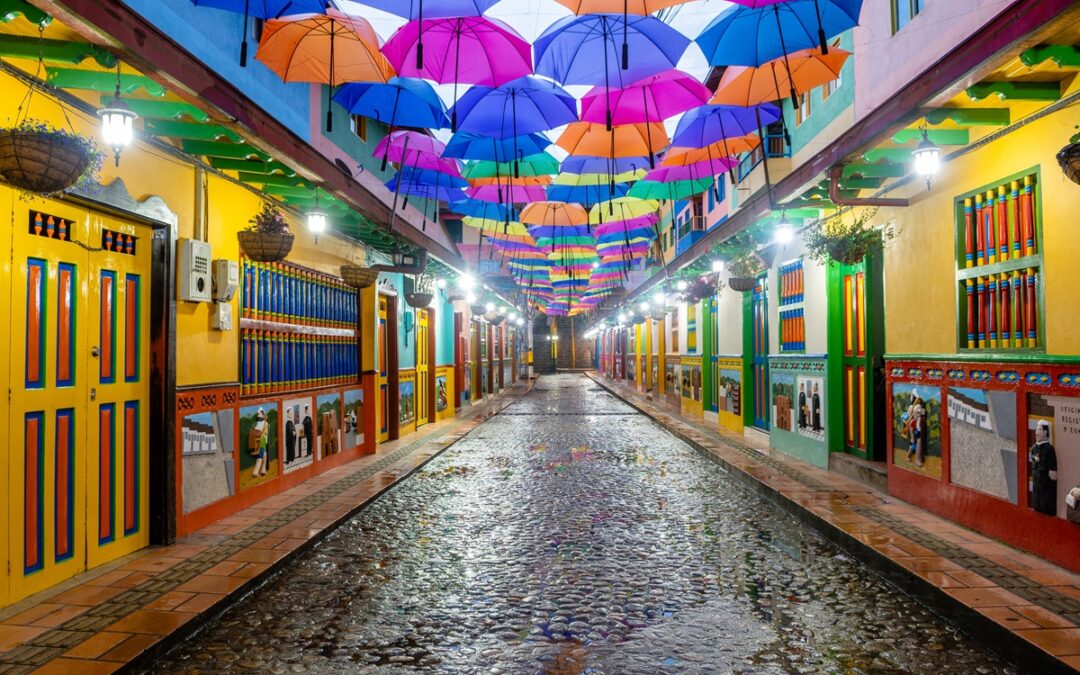
If modern urban life is often defined by a palette of steel grays and glass blues, Latin America offers a defiant, joyful counter-narrative. From the Caribbean coast of Colombia to the steep hills of Chile, the region is dotted with towns that don’t just feature color—they live in it.
But for the discerning traveler, the appeal of these destinations goes beyond the perfect Instagram backdrop. In Latin America, color is rarely just decoration; it is history, resistance, utility, and identity. The ochre walls of a Mexican pueblo might honor a Mayan sun god; the mismatched tin sheets of an Argentine barrio tell the story of immigrant resilience.
For PanamericanWorld, we journeyed to five of the region’s most vibrant towns to uncover the stories behind their hues.
1. The Golden City: Izamal, Mexico
In the heart of the Yucatán Peninsula, about 72 kilometers east of Mérida, lies a town that glows with the intensity of the sun itself. Izamal is known as La Ciudad Amarilla (The Yellow City), and it is startlingly monochromatic. Every colonial arch, every shopfront, and the massive 16th-century Convento de San Antonio de Padua is painted a rich, egg-yolk yellow with white trim.

The Story Behind the Color: Why yellow? The most popular local legend attributes the makeover to the 1993 visit of Pope John Paul II. To honor the Pontiff, the town supposedly painted itself in the Vatican’s colors (yellow and white). However, anthropologists suggest a deeper, more ancient root. Izamal was a pilgrimage site for the Maya long before the Spanish arrived, dedicated to Kinich Kakmó, the Sun God. For the Maya, yellow is a sacred color representing corn and the life-giving sun. Today, the city is a “Pueblo Mágico” where the colonial layer sits directly atop the pre-Hispanic—quite literally, as the convent was built with stones from a dismantled Mayan pyramid.
The Traveler’s Take: Walking through Izamal feels like stepping into a sepia photograph that has suddenly burst into gold. It is quiet, regal, and fiercely hot.
Panamerican Tip: Visit the Kinich Kakmó pyramid, located right in the center of town. It is one of the largest in Mexico by volume. Climb it at sunset; looking down, the yellow town against the green jungle creates a contrast you won’t forget.
2. The Bas-Relief Masterpiece: Guatapé, Colombia
Two hours from Medellín, the lakeside town of Guatapé offers a different kind of vibrancy. While many colonial towns rely on a uniform color code, Guatapé is a riot of individual expression. The lower half of almost every building is adorned with zócalos—brightly colored, three-dimensional bas-reliefs.
The Story Behind the Color: The tradition is surprisingly young, dating back to the early 20th century, but it has become the town’s soul. Originally, these zócalos were simple geometric designs meant to protect the walls from chickens pecking at the whitewash. Over time, they evolved into complex storytelling devices. A bakery might feature zócalos of bread loaves; a shoemaker’s house might show boots. Others depict rural scenes, llamas, sunflowers, or local history. It is an open-air democratic gallery where every homeowner tells their own story through color and cement.
The Traveler’s Take: Guatapé is undeniably touristic, especially given its proximity to the massive Rock of Guatapé (El Peñol), but the craftsmanship of the zócalos rescues it from feeling like a trap. It feels handcrafted and personal.
Panamerican Tip: Don’t just stick to the waterfront Malecón. Head to the Plazoleta de los Zócalos, a small square exploding with color, and grab a coffee. Ask a local guide to explain the specific meaning behind the zócalos on the Calle del Recuerdo; some depict the history of the town before the hydroelectric dam flooded the old valley.
3. The Bohemian Amphitheater: Valparaíso, Chile
Pablo Neruda, Chile’s Nobel Laureate, called Valparaíso a city that “has never combed its hair.” He was right. Spilling chaotically down 42 hills toward the Pacific Ocean, “Valpo” is a gritty, poetic mess of corrugated iron, Victorian mansions, and some of the world’s best street art.

The Story Behind the Color: Valparaíso’s palette was born of poverty and practicality. As a major port before the opening of the Panama Canal, the city was full of shipyards. Residents of the cerros (hills) would scavenge leftover boat paint to weather-proof the zinc siding of their homes. Since they rarely had enough of one color for a whole house, the hillsides became a patchwork of surplus naval reds, blues, and yellows. Today, that impromptu aesthetic has been embraced by street artists who view the city’s walls as a canvas, turning Valparaíso into a global capital of graffiti and murals.
The Traveler’s Take: This is not a manicured Disney version of color. Valparaíso is raw. You ride the rickety ascensores (funiculars) up the steep slopes to find a labyrinth of alleyways where every turn reveals a mural that might be political satire or pure psychedelic fantasy.
Panamerican Tip: Visit La Sebastiana, one of Neruda’s three houses, located on Cerro Florida. It offers a bird’s-eye view of the colorful “amphitheater.” Afterward, walk down through the Cerro Alegre and Cerro Concepción districts for the best art spotting.
4. The Afro-Brazilian Soul: Salvador de Bahia (Pelourinho), Brazil
In Brazil’s first capital, color is synonymous with rhythm. The historic center of Salvador, known as the Pelourinho (or simply “Pelô”), is a UNESCO World Heritage site that boasts the largest collection of colonial baroque architecture in the Americas.

The Story Behind the Color: The pastel blues, pinks, and yellows of the Pelourinho’s facades hide a dark history; this was once the center of the slave trade. The name itself refers to the whipping post. However, since a massive restoration project in the 1990s, the area has been reclaimed as a center of Afro-Brazilian culture and pride. The colors here don’t just preserve the Portuguese aesthetic; they serve as a backdrop for the vibrant white lace of the Baianas selling acarajé and the thunderous drums of the Olodum percussion groups. The color here feels kinetic—it vibrates with the music.
The Traveler’s Take: Salvador is intense. The heat, the humidity, and the history press in on you. The colorful facades of the churches, like the azure Igreja de Nossa Senhora do Rosário dos Pretos, are striking against the tropical sky.
Panamerican Tip: Visit on a Tuesday night. This is the traditional party night in the Pelourinho, known as the Terça da Benção (Tuesday of the Blessing). The colored streets fill with drumming, dancing, and capoeira circles.
5. The Tango on Tin: La Boca (Caminito), Buenos Aires
Perhaps the most recognizable colorful street in South America, El Caminito in the La Boca neighborhood of Buenos Aires is a museum of immigrant life.

The Story Behind the Color: Like Valparaíso, La Boca was a port district, home to thousands of Genoese immigrants in the late 19th and early 20th centuries. They lived in conventillos (tenement houses) built from scrap metal and wood. Lacking money for building materials, they used leftover marine paint from the docks. The result was a patchwork of primary colors that became the neighborhood’s signature. In the 1950s, local artist Benito Quinquela Martín revived the declining area by painting the walls in those original bright colors and encouraging the return of Tango culture.
The Traveler’s Take: While Caminito is a short pedestrian street (barely 100 meters), it captures the melodramatic soul of the Tango. The colors are aggressive and bold—fire engine red, deep blue, bright yellow—matching the passion of the dancers who perform for tourists on the cobblestones.
Panamerican Tip: La Boca is best enjoyed during the day. After walking Caminito, visit the nearby Fundación Proa, a contemporary art museum. The contrast between the hyper-colorful history of the street and the clean, white minimalism of the museum offers a perfect perspective on how Buenos Aires bridges the past and future.
The Verdict
In a globalized world where architecture often tends toward the beige and the glass-clad, these towns remind us that color is a language. Whether it is the sacred yellow of the Maya or the pragmatic boat-paint patchwork of the port, these hues tell us who lived here, what they believed, and how they survived.
So, the next time you plan a trip south of the Rio Grande, don’t just look for the beach. Look for the color. It’s where the stories are.
Photo of the portrait: Guatape, Colombia, taken from Depositphotos