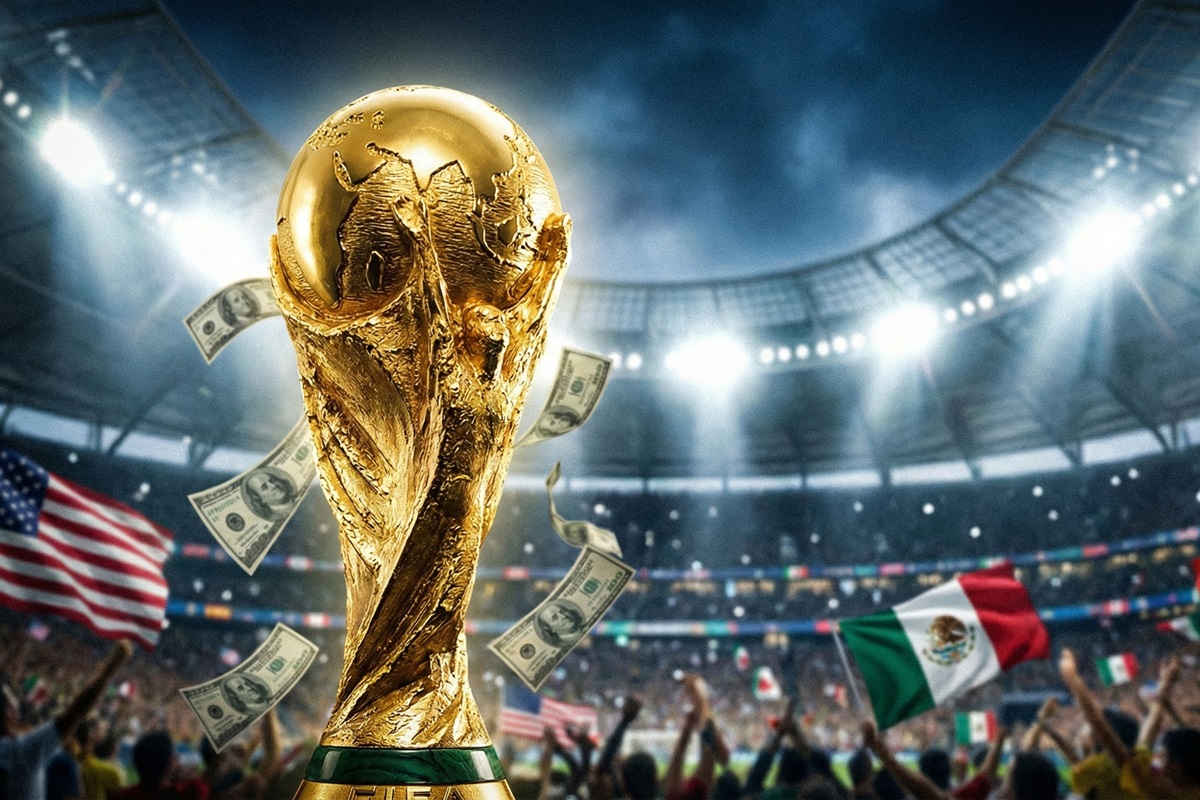
Defending a World Cup title is never a formality. Even less so when it involves a national team that ended a historic drought, reconciled with its people, and elevated its captain into soccer’s ultimate pantheon. Argentina will arrive at the 2026 FIFA World Cup as the reigning champion, carrying a label that inspires as much as it weighs. The question is not whether the team has talent. The real question is whether it can do it again.
The draw held on December 5 in the United States placed Argentina in Group J alongside Austria, Algeria, and Jordan. On paper, it looks manageable. But World Cups are decided by timing, by adaptation to new scenarios, and by the ability to renew without breaking what already works.
The starting point
Argentina is not heading into 2026 living off memories. After Qatar 2022, the team went on to win the 2024 Copa América, dominate the South American qualifiers, and preserve a recognizable identity. That matters. Many champion teams drift into an emotional limbo after reaching the summit. This one did not.
Under Lionel Scaloni, Argentina has consolidated a clear idea: measured intensity, intelligent pressing, talent surrounded by balance, and a unified dressing room. This team does not depend on a single inspired night. It functions collectively, and that is reflected both in results and in the understanding among its players.
Group J: Comfortable, but not naïve
Austria appears to be the toughest obstacle in the group. Coached by Ralf Rangnick, the team has built an identity based on high pressing, European tempo, and collective organization. It lacks the historical pedigree of a traditional powerhouse, but it has a structure that punishes mistakes.
An Argentina–Austria matchup could turn into a high-voltage tactical battle, especially if both sides are fighting for first place. It will not be a game for speculation.

Algeria arrives with an old wound still open from 2014, when it came within minutes of eliminating Germany, the eventual champion. That generation left its mark. This one wants to rewrite the story. With Riyad Mahrez as a reference point and a solid qualifying campaign, Algeria is an uncomfortable opponent, capable of competing on the biggest stage.
Jordan will make its World Cup debut in 2026. On paper, the weakest team in the group. In practice, a disciplined side with regional experience and no pressure. That profile can be dangerous in an expanded tournament with 48 teams.
Related article: How much money will the 2026 World Cup champion earn?
The Messi factor
Talking about Argentina at the 2026 World Cup inevitably leads to Lionel Messi. But not in the same way as before. The Messi of 2026, if he is there, will not be the one carrying everything. He will be the one who organizes, decides, and appears when needed.

His present at Inter Miami CF shows continuity, physical care, and influence. At 38, Messi has nothing left to prove. That is precisely why his possible presence adds value without becoming a dependency. This team has learned to play with him and without him. That is one of Argentina’s greatest assets.
The core that sustains the dream
The backbone of the champions remains intact. Emiliano Martínez, Cristian Romero, Rodrigo De Paul, Alexis Mac Allister, Enzo Fernández, Julián Álvarez, and Lautaro Martínez will arrive in 2026 at full competitive maturity. They are no longer prospects. They are established players.
Around them, renewal is progressing without urgency. Names like Nicolás Paz, Valentín Barco, Franco Mastantuono, and Alejandro Garnacho represent an orderly transition rather than a rupture.
That balance between continuity and renewal is historically rare among defending champions. Argentina has managed to achieve it.
Not everything is continuity, though. There are definitive departures and leadership roles coming to an end. Ángel Di María and Franco Armani will not be there. Nicolás Otamendi, at 37, is aiming for one final World Cup. These changes demand fine adjustments, especially in defense.
There are also returns. Giovani Lo Celso and Nicolás González, both absent in Qatar due to injury, are back on the radar. They are not new additions, but familiar pieces Scaloni knows how and when to use.
A new kind of World Cup
The 2026 World Cup will be unlike any other. Forty-eight teams, 104 matches, three host countries, long travel distances. Physical and mental wear will be greater. Logistics will be part of the competition. Argentina, interestingly, starts with an advantage in the group stage: only one long trip and two matches in the same city.
In a tournament like this, squad rotation and calendar management can be as decisive as talent. And that is where Scaloni has already shown his ability to compete.
If Argentina wins Group J, it would avoid early clashes with European giants. The format protects higher-ranked teams until the later stages. That guarantees nothing, but it does shape the bracket.
Potential matchups against teams like Spain, France, or England would likely come in the semifinals or final. And in that territory, Argentina already knows how to play decisive games.
Can Argentina repeat in 2026?
History says it is difficult. Modern football suggests it is possible.
Argentina has:
- A stable coaching staff.
- A champion core in its prime.
- A leader who adds without constraining.
- A tested renewal process.
- Confidence without arrogance.
It does not arrive as an invincible team. It arrives as a mature one. And that distinction matters.
The real challenge
Argentina’s biggest risk in 2026 will not be Austria, Algeria, or Jordan. It will be believing the path is already paved. Qatar left an unforgettable lesson: you can fall and get back up. But there is not always room for recovery.
If Argentina manages to sustain its hunger, handle egos, and understand that defending a title means starting from zero, it will not only have real chances. It will have concrete arguments to fight until the very end.
A champion does not fade away. It reinvents itself. And today, the Albiceleste seems to know exactly how to do that.