
Latin America is widely known for its passion for soccer and baseball, but the region has also produced some of the most formidable talents in boxing history. From thunderous punches to masterful footwork, Latin American fighters have left a deep mark on the sport, shaping its mythology across several generations.
But among so many champions, who truly deserves to be called a legend? PanamericanWorld takes a closer look at the defining moments of 10 boxing icons who earned their place in the pantheon of Latin American greatness.
JULIO CESAR CHAVEZ, THE GREAT MEXICAN BOXING CHAMPION (MEXICO)
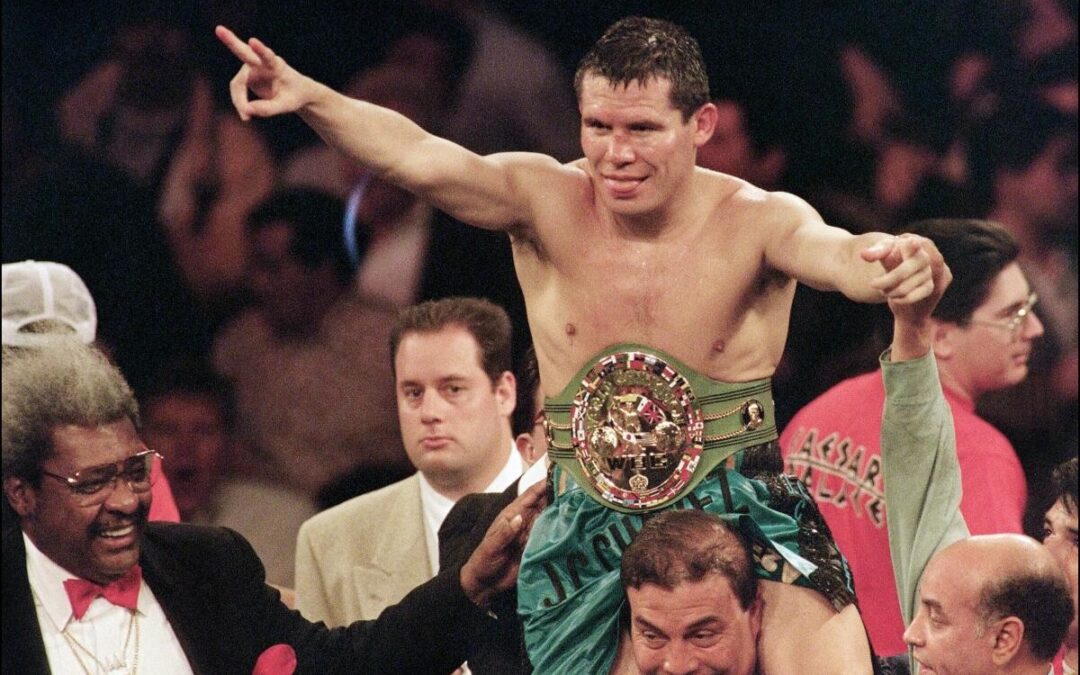
Julio César Chávez stands at the top of this list with a career that still feels almost impossible to repeat. The Mexican icon became world champion in three weight divisions: super featherweight, lightweight and light welterweight. His résumé includes some of the most remarkable numbers in boxing history.
Chávez fought in 37 world title bouts, a record that helped define his legacy. He also remained undefeated for 13 years, 11 months and 24 days, building one of the most extraordinary unbeaten runs ever seen in the sport. His official professional record is widely listed as 107 wins, 6 losses and 2 draws, with 85 knockouts.
His pressure fighting, brutal body punching and astonishing durability made him the standard against which every great Mexican fighter is still measured. ESPN ranked him among the 50 greatest boxers in history, while The Ring placed him among the best fighters of the modern era.
CARLOS MONZON, THE IRON ARGENTINE (ARGENTINA)
Carlos Monzón remains one of the greatest middleweights boxing has ever produced. The Argentine ruled the division from 1970 to 1977 and defended his world middleweight crown 14 times. During that reign, he defeated elite opponents such as Emile Griffith, Bennie Briscoe, José “Mantequilla” Nápoles, Rodrigo Valdés and Nino Benvenuti.
Monzón finished his professional career with a record of 87 wins, 3 losses and 9 draws, with 59 knockouts. His style was cold, efficient and punishing. He was not a flashy fighter, but he controlled distance with authority, imposed his rhythm and broke opponents down with a terrifying calm.
In 1990, he was inducted into the International Boxing Hall of Fame. The Ring has also ranked him among the greatest pound-for-pound fighters of all time.
Away from the ring, Monzón’s life ended in darkness. He was convicted of murdering his partner, Alicia Muñiz, and sentenced to prison. In 1995, while on temporary release, he died in a car accident.
Related content: Top 10 Cuban Boxers of All Time
ALEXIS ARGUELLO, THE GENTLEMAN OF THE RING (NICARAGUA)
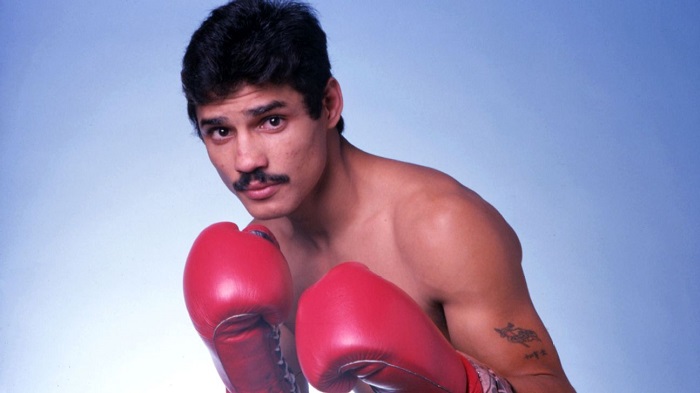
Alexis Argüello is Nicaragua’s greatest boxer and one of the most admired champions Latin America has produced. Elegant, precise and devastating, he combined technical intelligence with knockout power.
Argüello became world champion in three divisions: featherweight, super featherweight and lightweight. His professional record is currently listed by BoxRec as 77 wins and 8 losses, with 62 knockouts, although some historical sources have traditionally cited 82 wins and 65 knockouts.
His greatest nights included victories over Rubén Olivares, Alfredo Escalera, Bobby Chacón, Rafael Limón, Cornelius Boza-Edwards and Ray Mancini. He also became part of boxing history through his two brutal fights against Aaron Pryor, especially their first meeting in 1982, one of the most intense championship bouts of the era.
After retirement, Argüello entered politics and became mayor of Managua in 2008. A year later, Nicaragua was shaken by his death. The “Gentleman of the Ring” had taken his own life.
Related content: Top 10 Cuban Boxers of All Time
ROBERTO “HANDS OF STONE” DURAN (PANAMA)
Roberto Durán spent more than three decades in professional boxing, from 1968 to 2001. His nickname, “Hands of Stone,” captured the destructive force of his punches, but Durán was far more than a brawler. He was a defensive master, a ring general and one of the most complete fighters in boxing history.
Durán won world titles in four weight divisions. In 1972, he defeated Ken Buchanan to become lightweight champion. Then, In 1980, he beat Sugar Ray Leonard in the famous “Brawl in Montreal” to win the welterweight title. In 1983, he stopped Davey Moore to become junior middleweight champion. In 1989, at an age when most fighters are already finished, he defeated Iran Barkley to win the middleweight title.
His final professional record was 103 wins and 16 losses, with 70 knockouts. In 1999, the Associated Press ranked him among the greatest fighters of the 20th century. For many historians, Durán is the finest lightweight of all time.
WILFREDO GOMEZ, THE BAZOOKA IN THE RING (PUERTO RICO)
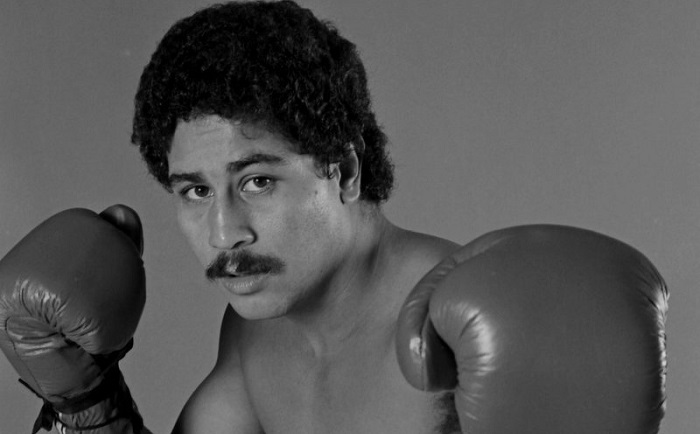
Wilfredo Gómez was one of the most explosive punchers in boxing history. Before turning professional, he became amateur world champion in Havana in 1974, at only 18 years old.
After a draw in his professional debut, Gómez built a fearsome streak of 32 consecutive knockout victories. In 1977, he won the WBC super bantamweight title by stopping South Korea’s Dong Kyun Yum in the 12th round in Puerto Rico.
Gómez became a dominant champion at 122 pounds. He defended his super bantamweight crown 17 times, and every one of those defenses ended by knockout. His list of defeated opponents included Carlos Zárate, Lupe Pintor, Juan Meza and Leo Cruz.
He retired with a professional record of 44 wins, 3 losses and 1 draw, with 42 knockouts. In 1995, he was inducted into the International Boxing Hall of Fame.
FELIX “TITO” TRINIDAD (PUERTO RICO)
Félix “Tito” Trinidad is one of Puerto Rico’s most beloved sports figures and one of the most exciting punchers of his generation. He turned professional at 17 and became a world champion three years later.
Trinidad won world titles in three divisions: welterweight, light middleweight and middleweight. His left hook became one of the most feared weapons in boxing, and his aggressive style turned him into a must-watch fighter throughout the 1990s and early 2000s.
One of his most famous victories came in 1999, when he defeated Oscar De La Hoya in a highly anticipated welterweight unification fight. He later moved up in weight and continued collecting major wins, including victories over Fernando Vargas and William Joppy.
Trinidad finished his professional career with 42 wins and 3 losses, with 35 knockouts. Beyond the numbers, his legacy lives in the emotional bond he created with Puerto Rican fans, who saw in him a champion with power, pride and charisma.
TEOFILO STEVENSON (CUBA)
Teófilo Stevenson is one of the greatest amateur boxers in history. The Cuban heavyweight became a global symbol of Olympic boxing and one of the most respected fighters of the 20th century.
Stevenson won three Olympic gold medals: Munich 1972, Montreal 1976 and Moscow 1980. He also captured three world amateur titles and became the dominant heavyweight of his era outside the professional ranks.
His amateur record is traditionally listed as 301 wins in 321 fights, though historical records vary depending on the source. What does not vary is the scale of his dominance. Stevenson combined size, reach, timing and devastating power. He did not simply win; he often overwhelmed opponents with a calm authority that made him appear untouchable.
He was also famously linked to the question of what might have happened had he turned professional and fought Muhammad Ali. Stevenson chose to remain in Cuba and became an enduring national icon. His death in 2012, at age 60, moved the boxing world.
FELIX SAVON (CUBA)

Félix Savón continued Cuba’s heavyweight tradition after Teófilo Stevenson and built one of the richest amateur careers boxing has ever seen. He won three Olympic gold medals: Barcelona 1992, Atlanta 1996 and Sydney 2000. He also captured six world amateur championships, a staggering achievement that placed him among the most decorated fighters in the history of the sport.
Savón was not as spectacular a knockout artist as Stevenson, but he was brutally effective. His jab, straight right hand and physical strength made him a nightmare for opponents. He fought in an era when amateur boxing used headgear and scoring systems that often rewarded precision over destruction, yet he still imposed himself with overwhelming authority.
MARCO ANTONIO BARRERA, “BARRETA” (MEXICO)
Marco Antonio Barrera was one of the defining Mexican fighters of the late 1990s and early 2000s. He turned professional at only 15 and grew into a complete boxer, capable of going to war or fighting with intelligence from distance.
Barrera became a world champion in three divisions: super bantamweight, featherweight and super featherweight. His first world title came in 1995, when he defeated Daniel “Cobra” Jiménez to win the WBO super bantamweight crown.
His career changed forever in 2001, when he defeated Naseem Hamed in Las Vegas. Barrera entered that fight as the underdog, but he outboxed and humbled one of the most flamboyant stars in the sport. He later added major victories over Erik Morales, Johnny Tapia, Kevin Kelley and Paulie Ayala.
Barrera finished his professional career with 67 wins, 7 losses and 1 no contest, with 44 knockouts. He was inducted into the International Boxing Hall of Fame in 2017.
JUAN MANUEL MARQUEZ (MEXICO)

Juan Manuel Márquez was one of the most technically gifted Mexican boxers of all time. A master counterpuncher with uncommon patience and intelligence, he built a career defined by precision, resilience and courage.
Márquez became world champion in four divisions: featherweight, super featherweight, lightweight and junior welterweight. His final professional record was 56 wins, 7 losses and 1 draw, with 40 knockouts.
His rivalry with Manny Pacquiao became one of the great sagas of modern boxing. They fought four times. The first bout ended in a draw, Pacquiao won the next two by close decisions, and Márquez produced the defining moment of the rivalry in 2012, knocking Pacquiao out cold in the sixth round of their fourth fight.
Márquez also fought Floyd Mayweather Jr., losing by decision in 2009. But his place in history was never defined by that defeat. It was built on his craft, his durability and his ability to adapt under pressure.
Among Mexico’s many boxing legends, Márquez occupies a special place: the strategist, the technician, the fighter who could turn a single opening into a historic finish.




Trackbacks/Pingbacks