Caribbean athletes have played an extraordinary role in Olympic history. From Cuban fencer Ramón Fonst’s triumph in Paris in 1900 to the historic performances of Mijaín López, Julien Alfred, Marileidy Paulino and Thea LaFond at Paris 2024, athletes from the region have repeatedly transformed major Olympic events and, in several cases, delivered the first medals ever won by their countries.
Sprint events remain the Caribbean’s most recognizable Olympic territory, especially because of Jamaica’s dominance. But the region’s success stretches much further, through boxing, wrestling, fencing, javelin, hurdles and the triple jump.
Some Caribbean-born athletes represented other nations. Jamaican-born Linford Christie became Olympic 100-meter champion for Great Britain in Barcelona 1992, while Donovan Bailey, also born in Jamaica, won the same event for Canada at Atlanta 1996. Patrick Ewing, born in Jamaica, collected two basketball gold medals with the United States, including one as part of the legendary Dream Team in 1992.
Another example is Teddy Riner. Born in Guadeloupe and representing France, he has become one of the most successful judokas in Olympic history. His résumé expanded again at Paris 2024, where he won the individual +100 kg title and helped France retain the mixed team gold.
For this list, however, we focus primarily on athletes who reached the Olympic podium representing Caribbean countries.
Ramón Fonst (Fencing, Cuba)
Ramón Fonst occupies a unique place in Latin American and Caribbean sports history. At Paris 1900, the Cuban became the region’s first Olympic champion when he won the individual épée tournament at just 17 years old. He also earned silver in the masters épée competition.
Four years later, at the St. Louis Games, Fonst added three more titles, winning individual épée, individual foil and team foil. His career ended with four gold medals and one silver, an extraordinary haul for an athlete competing during the earliest period of the modern Olympic movement.
More than a century later, Fonst remains one of Cuba’s most accomplished Olympians.
Silvio Cator (Athletics, Haiti)
Haiti’s Olympic medal history is short, which gives Silvio Cator’s achievement an even greater place in the country’s sporting memory.
At Amsterdam 1928, Cator finished second in the long jump with 7.58 meters. A few weeks later, he set a world record of 7.93 meters in Paris.
His career eventually extended beyond athletics. Cator also played soccer and later entered politics, becoming mayor of Port-au-Prince. Haiti’s national stadium was subsequently named after him.
Hasely Crawford (Athletics, Trinidad and Tobago)
Hasely Crawford produced one of the defining Caribbean sprint performances of the 1970s.
At Montreal 1976, he won the men’s 100 meters in 10.06 seconds, beating Jamaica’s Donald Quarrie. The victory made Crawford Trinidad and Tobago’s first Olympic champion.
He later competed at Moscow 1980 and Los Angeles 1984, although he never returned to an Olympic final. His Montreal victory remains one of the fundamental moments in Trinidadian sports history.
Related Article: The 10 Fastest Caribbean Sprinters of All Time
Donald Quarrie (Athletics, Jamaica)
Before Usain Bolt, Asafa Powell and Jamaica’s modern generation of sprint stars, there was Donald Quarrie.
The Jamaican competed at five Olympic Games and collected four medals. His finest performance came at Montreal 1976, when he won the 200 meters and finished second behind Crawford in the 100.
Quarrie added bronze in the 200 meters at Moscow 1980 and silver with Jamaica’s 4×100-meter relay team at Los Angeles 1984.
His importance to Jamaican athletics is reflected at Kingston’s National Stadium, where a statue commemorates his career.
Merlene Ottey (Athletics, Jamaica)
Few athletes have shown the Olympic longevity of Merlene Ottey.
Between Moscow 1980 and Sydney 2000, she represented Jamaica at six Olympic Games. She later competed for Slovenia at Athens 2004, giving her seven Olympic appearances in total.
Ottey collected nine Olympic medals for Jamaica — three silver and six bronze — without ever winning gold. Her longevity and consistency made her one of the dominant figures in women’s sprinting for almost two decades.
The Olympic statistical record places her among the most successful female track and field athletes in Games history.
Keshorn Walcott (Athletics, Trinidad and Tobago)
Keshorn Walcott was only 19 when he shocked the javelin field at London 2012.
His throw of 84.58 meters gave Trinidad and Tobago its first Olympic gold medal since Crawford’s victory 36 years earlier. Four years later, Walcott returned to the podium in Rio, earning bronze with 85.38 meters.
His Olympic story continued well beyond those medals. At Paris 2024, competing in his fourth Games, he reached another Olympic final and finished seventh with a season-best 86.16 meters.
Shelly-Ann Fraser-Pryce (Athletics, Jamaica)
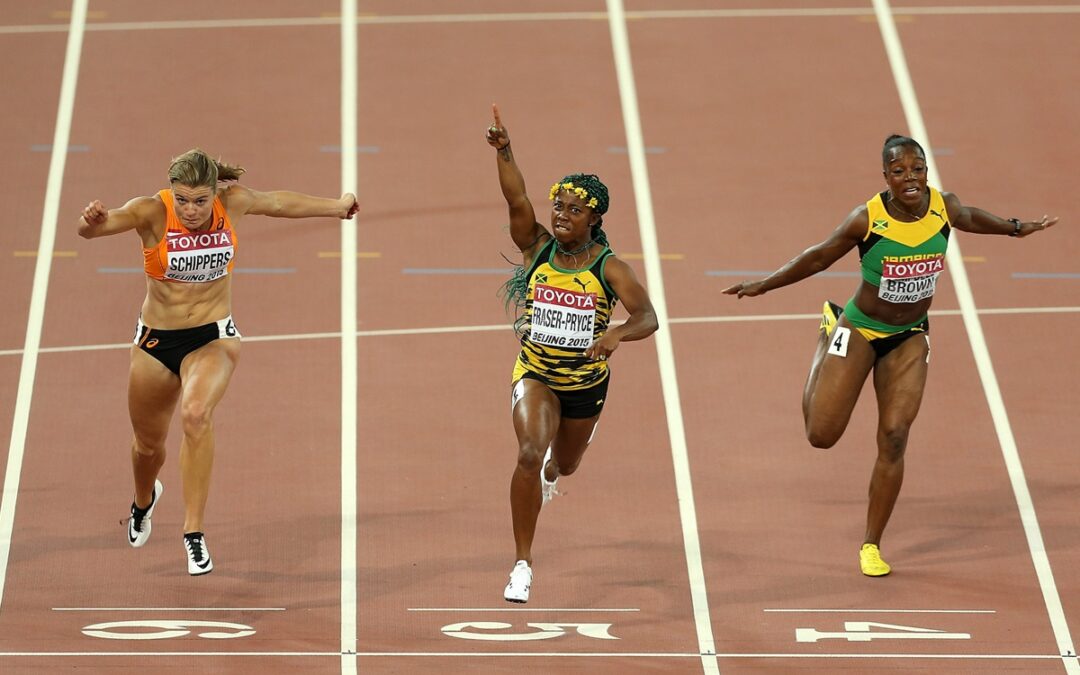
Fraser-Pryce won consecutive Olympic 100-meter titles at Beijing 2008 and London 2012. She also collected silver in the 200 meters and 4×100 relay in London, bronze in the 100 and silver in the relay at Rio 2016, then returned at Tokyo 2020 to win silver in the 100 and gold with Jamaica’s 4×100 team.
That gave her eight Olympic medals — three gold, four silver and one bronze.
She competed at her fifth Games in Paris in 2024, although an injury prevented her from running the 100-meter semifinal. Her elite career ended after the 2025 World Championships in Tokyo, closing nearly two decades at the highest level of international sprinting.
Félix Sánchez (Athletics, Dominican Republic)
Félix Sánchez established the standard for Dominican Olympic athletics long before the country’s current generation of champions arrived.
Born in New York to Dominican parents, Sánchez represented the Dominican Republic throughout his international career.
He won Olympic gold in the 400-meter hurdles at Athens 2004 with 47.63 seconds. Eight years later, at 34, he produced one of the great comeback performances in Olympic track and field and won again at London 2012 — remarkably, also in 47.63.
For years he was the Dominican Republic’s leading Olympic athletics reference. Paris 2024 introduced a new name into that conversation.
Usain Bolt (Athletics, Jamaica)
Usain Bolt’s Olympic numbers still look extraordinary years after his retirement.
From Beijing 2008 through Rio 2016, Bolt won the 100 and 200 meters at three consecutive Olympic Games. No other male sprinter has achieved that double three times in succession.
He finished his Olympic career with eight gold medals. A ninth was removed after Jamaica was disqualified from the Beijing 2008 4×100 relay following teammate Nesta Carter’s doping case. Olympic records continue to recognize Bolt as one of the most successful athletes in track and field history.
His world records of 9.58 seconds in the 100 meters and 19.19 in the 200, both set in 2009, also remain intact in 2026.
Teófilo Stevenson (Boxing, Cuba)
Cuban boxing has produced an extraordinary number of Olympic champions, but Teófilo Stevenson remains one of its most recognizable figures.
The heavyweight won three consecutive Olympic titles at Munich 1972, Montreal 1976 and Moscow 1980. His combination of reach, technique and punching power made him the dominant amateur heavyweight of his era.
Stevenson never turned professional despite repeated speculation about a possible fight with Muhammad Ali. Cuba’s absence from Los Angeles 1984 prevented him from attempting a fourth consecutive Olympic title.
Marileidy Paulino (Athletics, Dominican Republic)
Marileidy Paulino has rewritten the Dominican Republic’s Olympic record book.
She arrived at Paris 2024 already carrying two silver medals from Tokyo 2020 — one in the individual 400 meters and another in the mixed 4×400 relay.
In Paris she moved to another level. Paulino dominated the women’s 400-meter final and won gold in 48.17 seconds, breaking the Olympic record that had stood since Atlanta 1996. The victory made her the first Dominican woman to win an individual Olympic gold medal.
Her three-medal collection has already placed her alongside the central figures in Dominican Olympic history.
Kirani James (Athletics, Grenada)
Kirani James changed Grenada’s Olympic history in less than 44 seconds.
At London 2012, he won the 400 meters and delivered the country’s first Olympic medal of any color. He then demonstrated exceptional longevity, adding silver at Rio 2016 and bronze at Tokyo 2020.
The three medals, earned in the same individual event across three consecutive Games, established James as one of the Caribbean’s most consistent Olympic performers.
He returned for a fourth Olympics at Paris 2024 and again reached the 400-meter final.
Mijaín López (Wrestling, Cuba)
Any updated account of Caribbean Olympic greatness has to include Mijaín López.
The Cuban Greco-Roman wrestler won gold at Beijing 2008, London 2012, Rio 2016 and Tokyo 2020. He arrived at Paris 2024 at 41 years old with the opportunity to achieve something no athlete had accomplished before in an individual Olympic event.
López defeated Chile’s Yasmani Acosta in the 130 kg final and won his fifth consecutive Olympic gold medal. The achievement made him the first athlete in Olympic history to win the same individual event at five consecutive editions of the Games. Immediately after the final, he removed his shoes and left them on the mat, the traditional wrestling symbol of retirement.
Five Games. Five finals. Five gold medals. His Paris performance forced any discussion of the Caribbean’s greatest Olympians to expand beyond the sprint track.
Julien Alfred (Athletics, Saint Lucia)
Saint Lucia had never won an Olympic medal before Paris 2024. Julien Alfred changed that in 10.72 seconds.
Running in heavy rain at the Stade de France, Alfred defeated world champion Sha’Carri Richardson to win the women’s 100 meters. She became Saint Lucia’s first Olympic medalist and first Olympic champion in the same race.
Three days later, Alfred added silver in the 200 meters, finishing behind American Gabby Thomas in 22.08 seconds. Saint Lucia therefore left Paris with two medals, both won by the same athlete.
Her performance added another Caribbean nation to the Olympic sprint map already shaped for decades by Jamaica, Trinidad and Tobago, the Bahamas and Grenada.
Thea LaFond (Athletics, Dominica)
Paris 2024 also produced the greatest Olympic moment in Dominica’s history.
Thea LaFond won the women’s triple jump and gave the island its first Olympic medal — and immediately made it gold.
Her victory was part of a remarkable Games for smaller Caribbean nations. The International Olympic Committee later highlighted LaFond among the historic first-time medalists supported through Olympic Solidarity.
Paris 2024 therefore changed the geography of Caribbean Olympic success. Saint Lucia and Dominica joined the list of medal-winning nations, while Marileidy Paulino gave the Dominican Republic its first female individual Olympic champion and Mijaín López completed a feat unprecedented in more than a century of Olympic competition.
The names have changed across generations, from Fonst and Stevenson to Bolt, Fraser-Pryce, López, Paulino and Alfred. The Caribbean’s influence on Olympic history, however, has only grown.
Photo of the portrait: Depositphotos